
fancy (research) tools!Agentic engineering for everyone who works with knowledge.

With frontier language models and coding agents we develop tools, workflows and knowledge bases for your work processes, on commission, together with your team or in training. The basis is a precise understanding of your project and your data.

Offer

  • Learn

    In workshops and intensive days your team acquires the competence to work with coding agents and knowledge bases itself.

  • Develop together

    We develop together with your team on your data. The knowledge base remains with you and enables independent further development.

  • Commissioned development

    We develop the tool on your behalf, from a small application for a single work step to an agentic pipeline.

Models and data

Frontier language models are used in two places, as coding agents during development and in the finished tool for individual work steps such as text recognition, markup or the generation of structured data.

In both cases commercial as well as open models come into consideration, up to operation on your own hardware. Model and access are chosen together with you according to the nature and protection needs of the data. For development a few sample files, anonymised where required, are usually sufficient.

Costs

Billing depends on the task, by the hour, by working day or as a flat fee. The starting point is your budget. After an initial assessment we set out what is possible within it, and you decide after each step whether to continue.

  • The code is written predominantly by coding agents. The effort lies mainly in understanding your project together with you and in making the resulting systems comprehensible.
  • There are no licence fees for the software. Costs for the use of language models may be charged separately, depending on the scope of the project.
  • Where the use case allows, tools run in the browser and require no server of their own.
  • A small budget limits the scope, for example to a single work step.

Tools to adapt

  • LLM-assisted
  • Expert review in the tool
  • Overview of the whole collection
  • Readable text instead of tags
  • Runs in the browser without a server of its own
  • Evidence back to the source
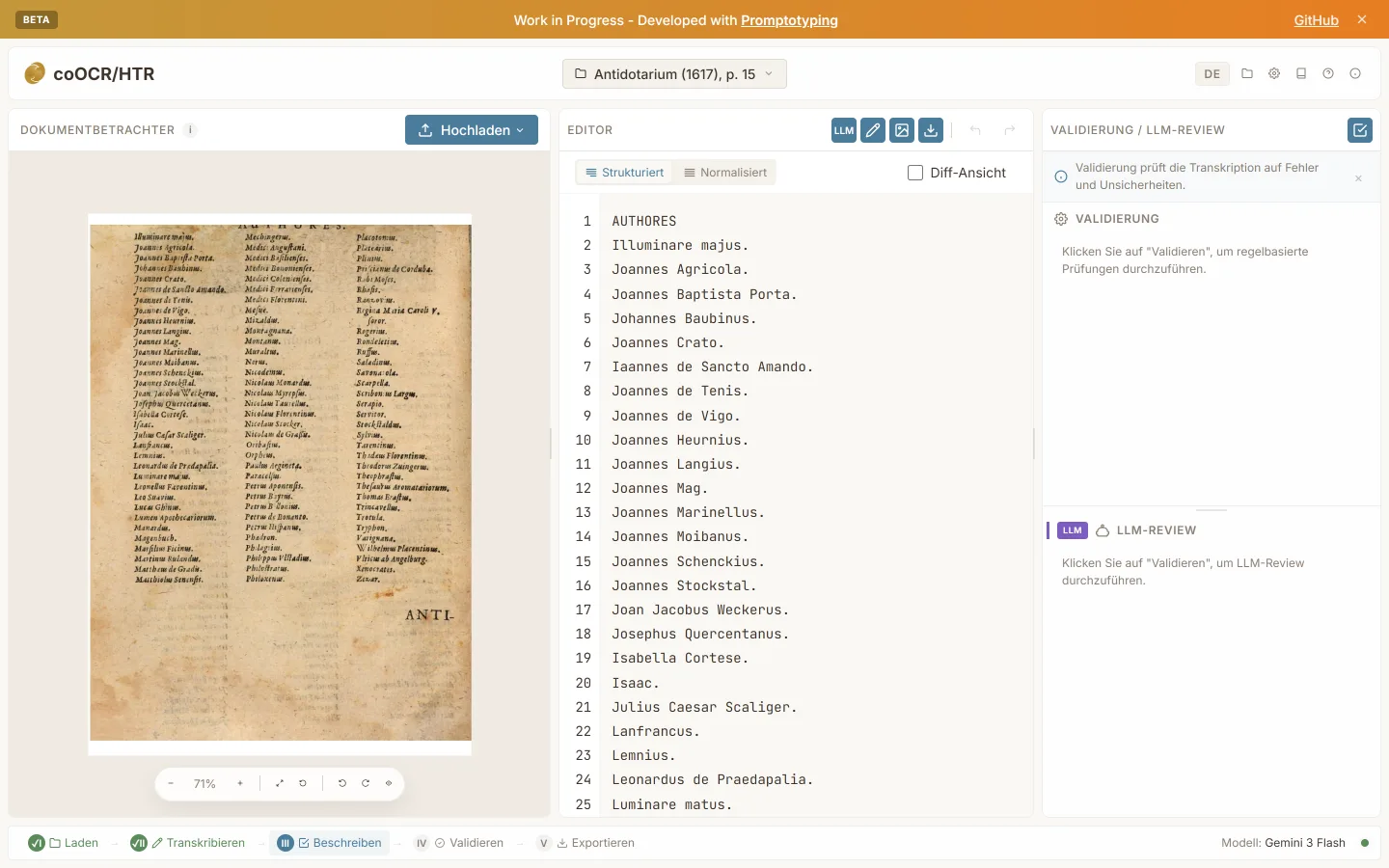
  • coOCR/HTR with the scan of a printed page on the left, the recognised transcription in the middle and the review panel on the right.

    coOCR/HTR

    Recognises the text of early printed books and manuscripts and lets every reading be checked against the page image.
    Research preview
    • LLM-assisted, model of your choice up to a local model
    • Expert review in the tool
    • Runs in the browser without a server of its own
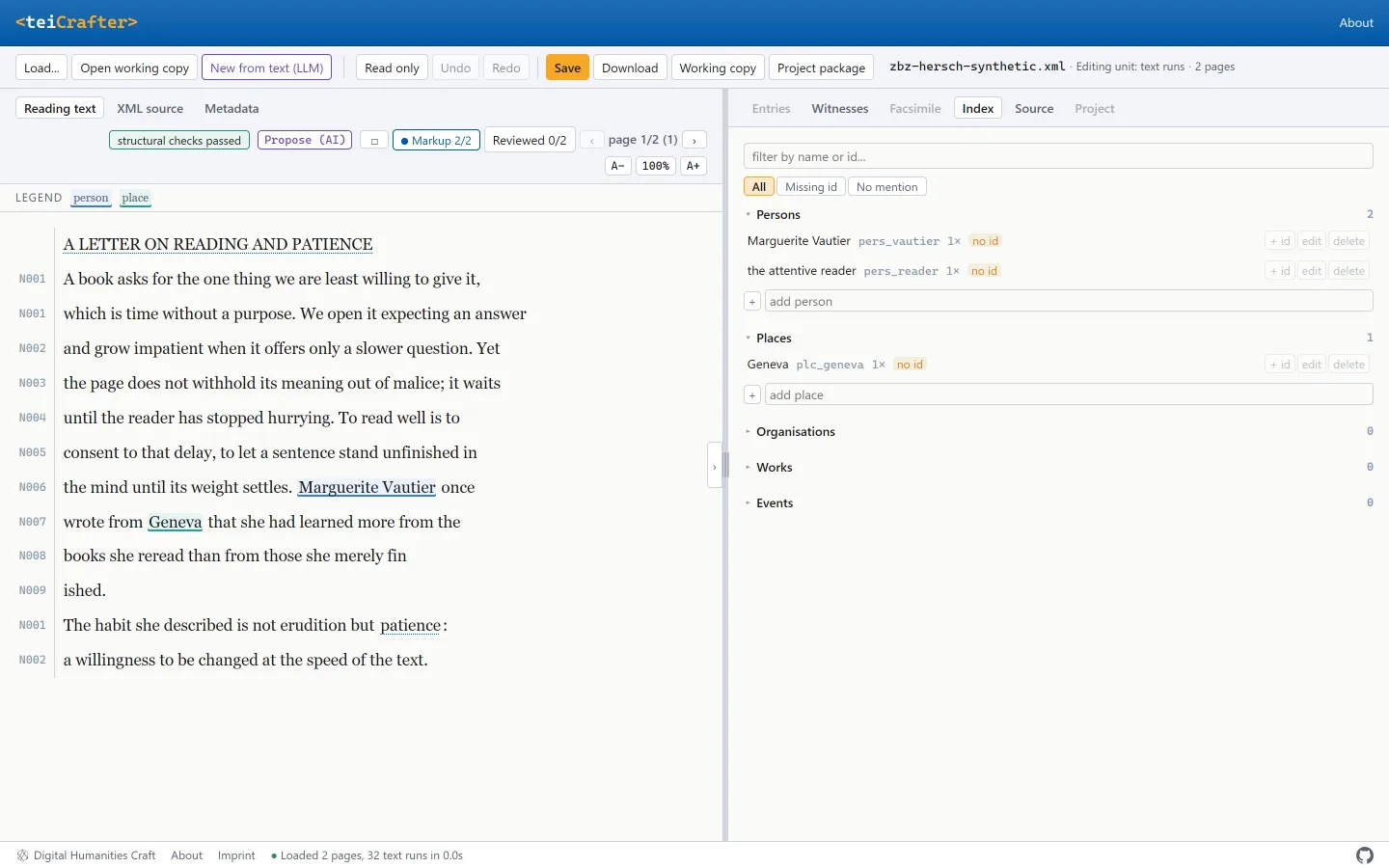
  • teiCrafter with readable letter text and marked persons and places on the left and the register of the persons and places mentioned on the right.

    teiCrafter

    Edits TEI XML as readable text and validates against the schema on saving.
    Research preview
    • LLM-assisted, model of your choice up to a local model
    • Readable text instead of tags
    • Expert review in the tool
    • Runs in the browser without a server of its own
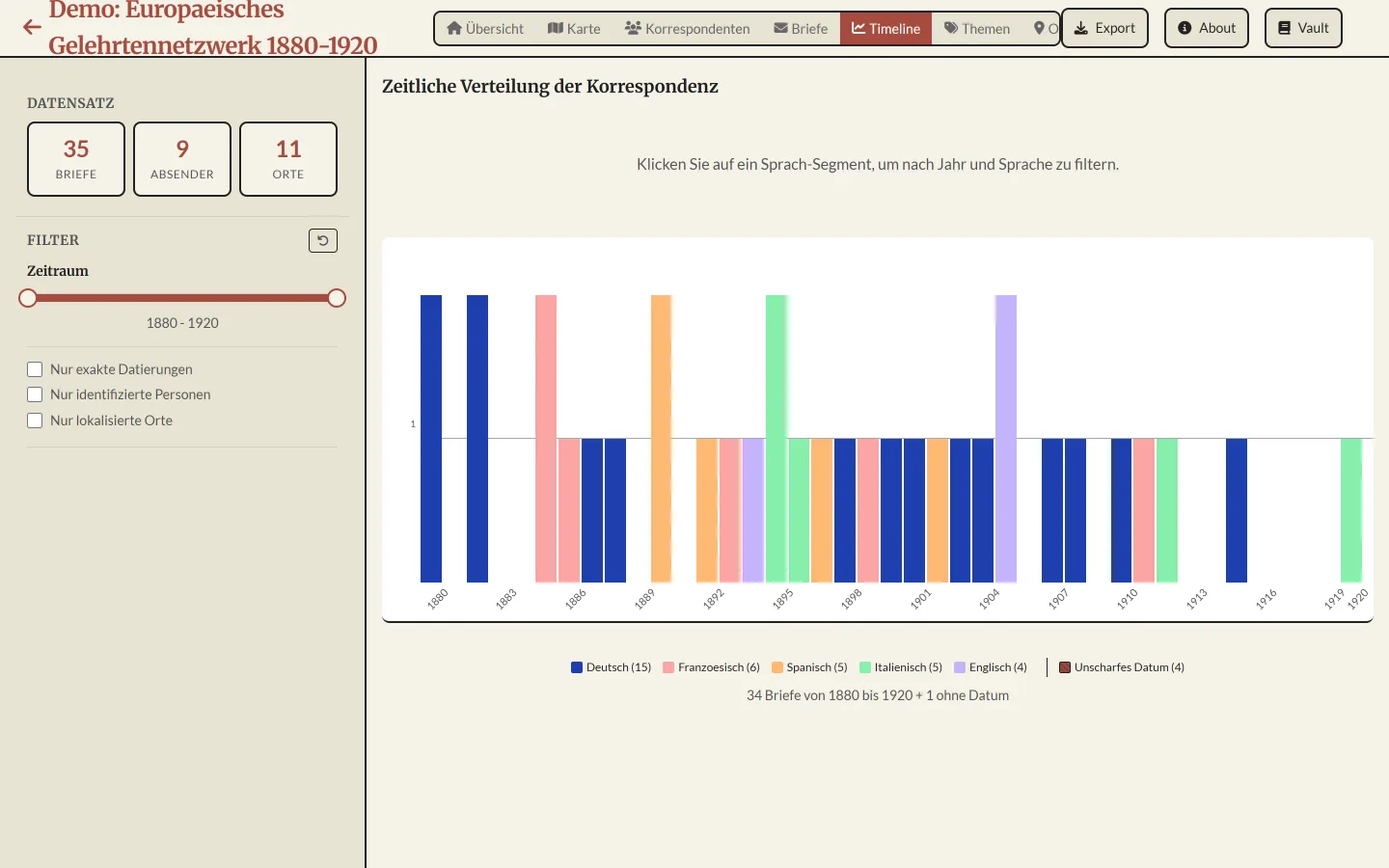
  • CorrespExplorer with a timeline of the letters in a demonstration collection, coloured by language, and filters along the left edge.

    CorrespExplorer

    Shows letter metadata from CMIF as a map, a timeline and a network, so that it becomes visible who wrote to whom, when and from where.
    Live demo
    • Overview of the whole collection
    • Runs in the browser without a server of its own
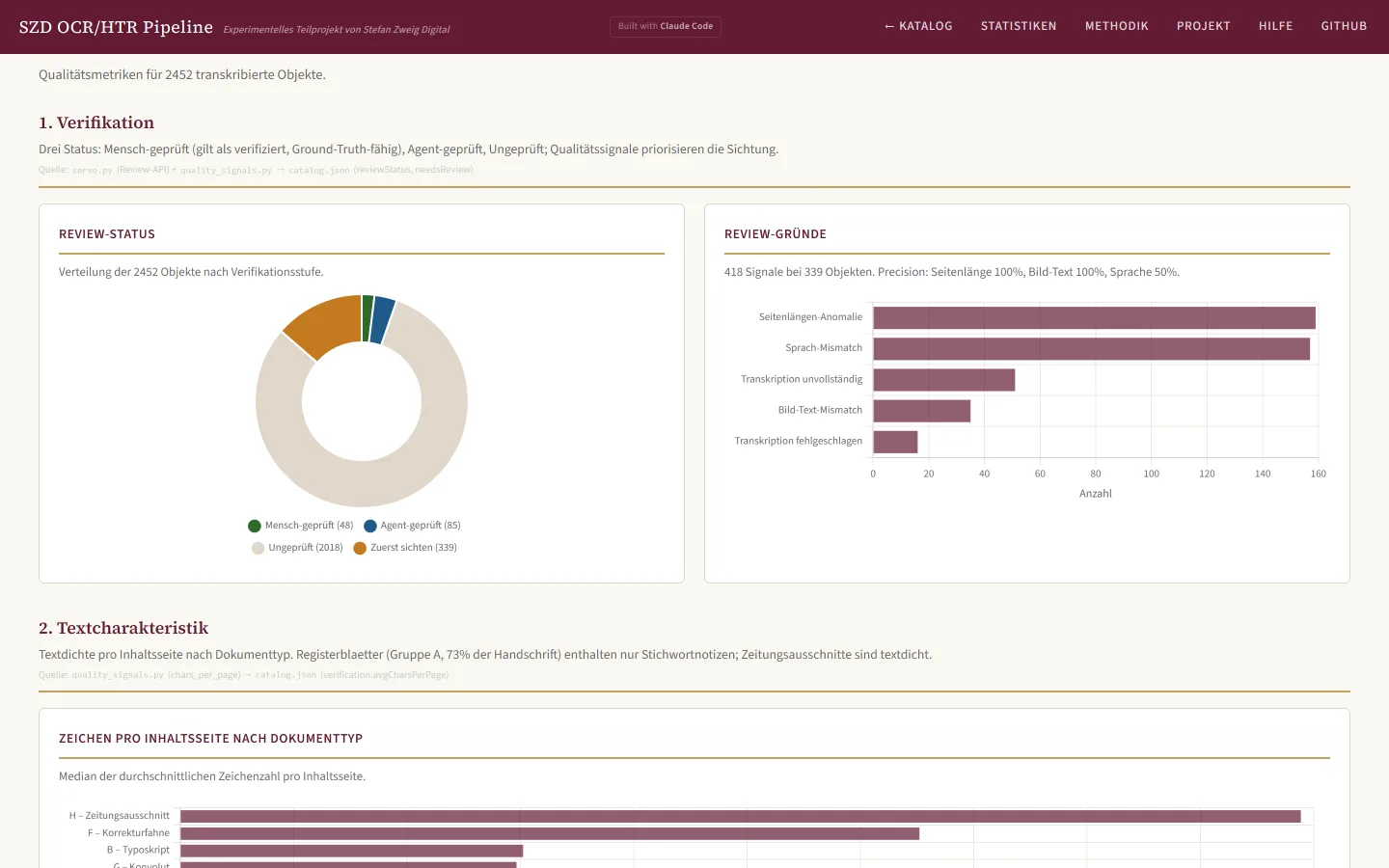
  • Statistics view of SZD-HTR with the distribution of objects by checking tier and the reasons why objects are marked for review.

    SZD-HTR

    Transcribes an entire estate and records for every object whether a machine, an agent or a human has checked it.
    Experiment
    • LLM-assisted
    • Overview of the whole collection
    • Expert review in the tool
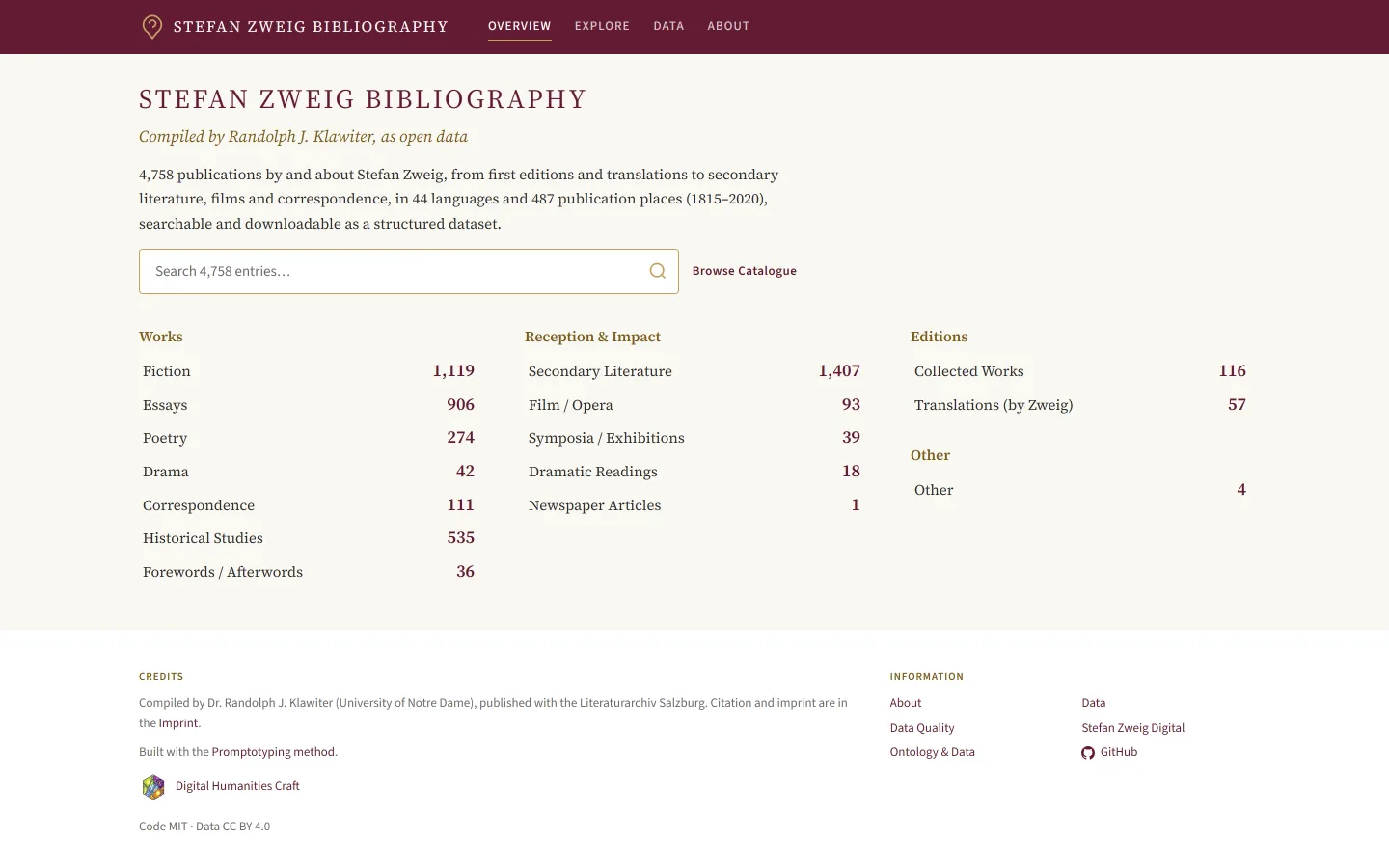
  • Interface of the Stefan Zweig Bibliography with a search across all entries and a breakdown by works, reception and editions.

    Stefan Zweig Bibliography

    Rescues a bibliography from a decommissioned wiki into research data in which every statement keeps its source page.
    Holdings secured
    • LLM-assisted
    • Overview of the whole collection
    • Evidence back to the source

Methods and frameworks

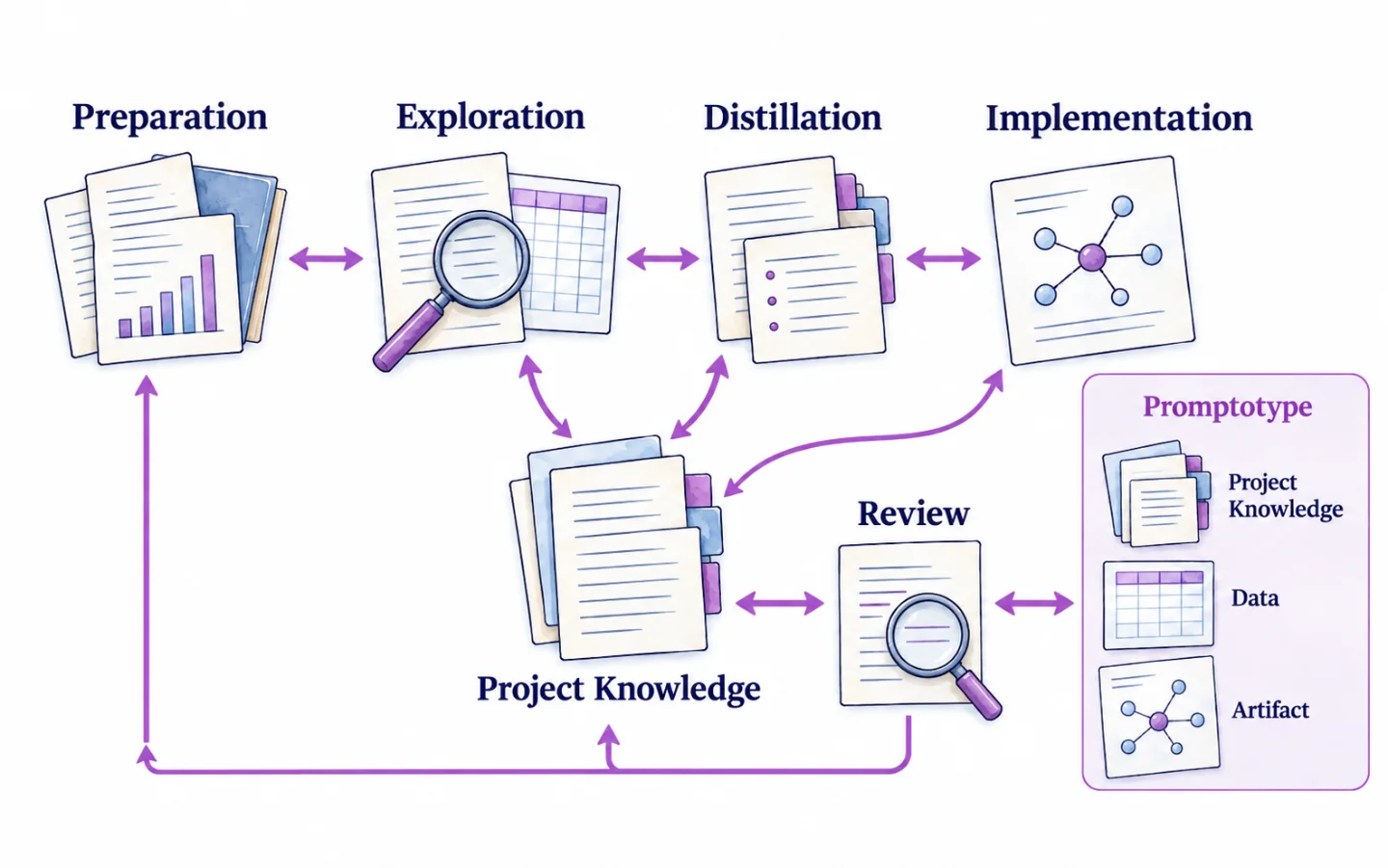
  • Promptotyping as a sequence from Preparation via Exploration and Distillation to Implementation, every step connected to the Project Knowledge, with a review leading to the Promptotype made of project knowledge, data and artefact.
    Generated with gpt-image

    Promptotyping

    Promptotyping develops research artefacts with AI agents out of a maintained knowledge base.
    In use
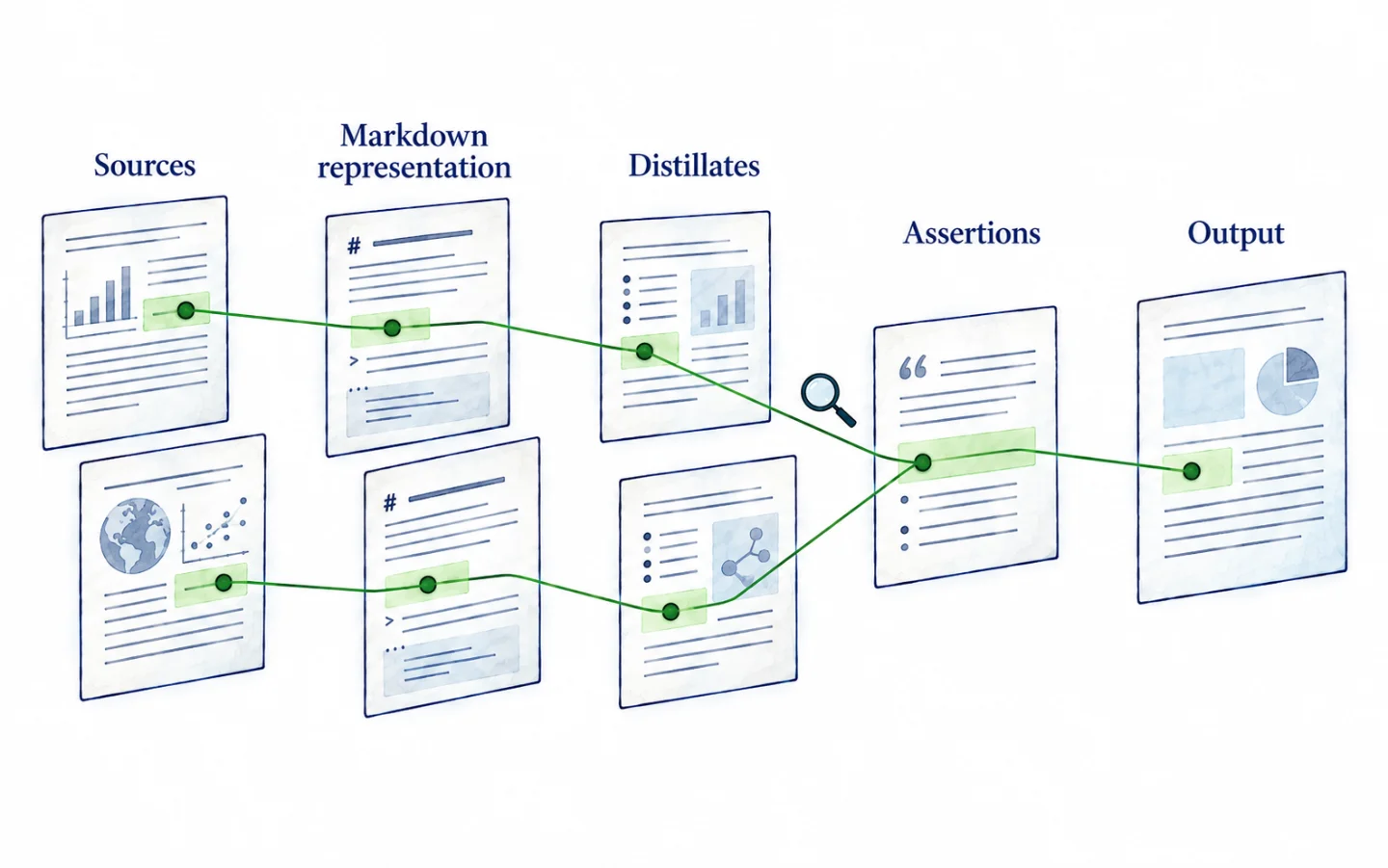
  • Grounded Vault as a chain from Sources via Markdown representation and Distillates to Assertions and Output, with a green line connecting every statement to its source passage.
    Generated with gpt-image

    Grounded Vault

    Grounded Vault leads every load-bearing claim in a report through a verifiable anchor back to the source passage.
    In use
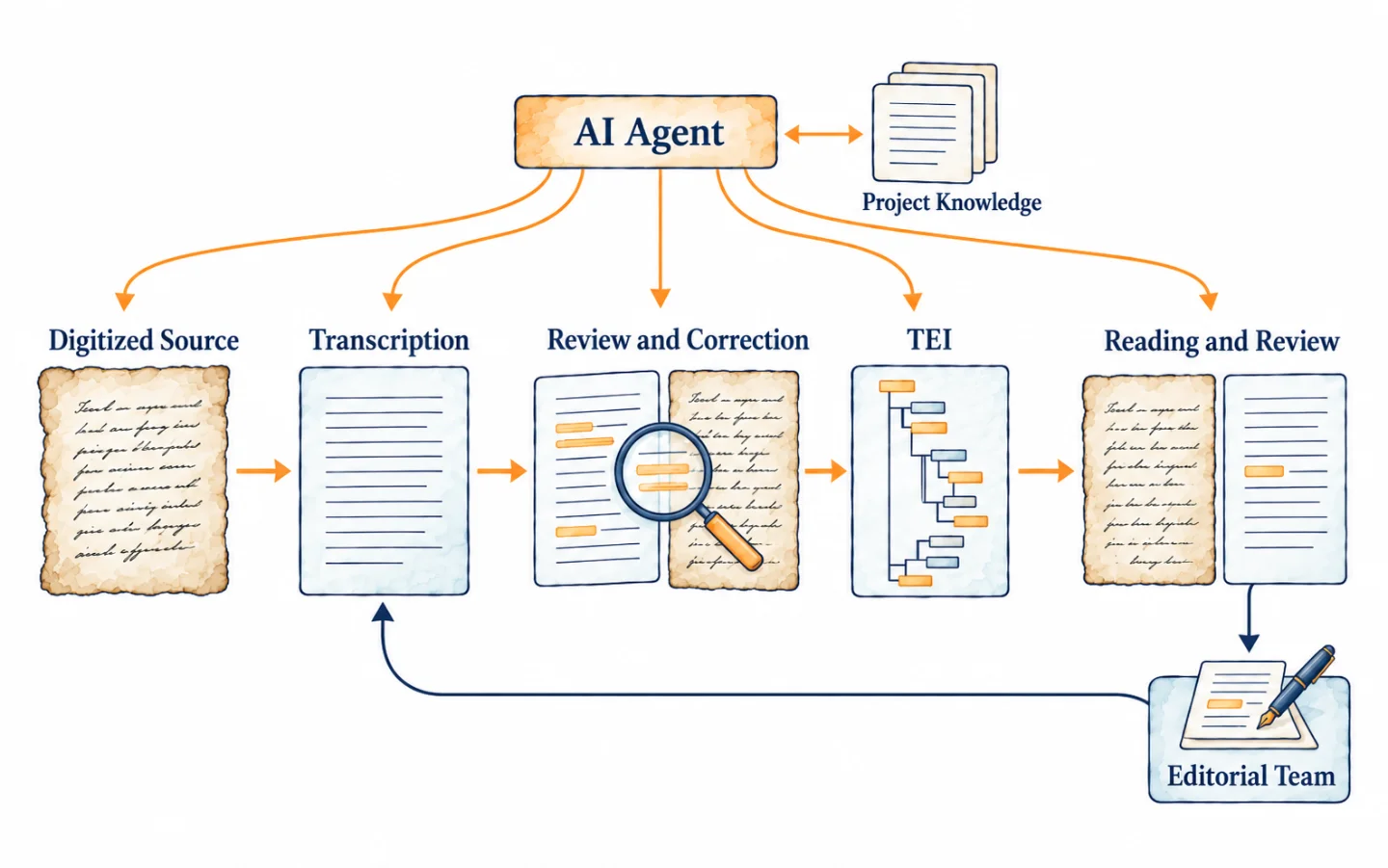
  • Agentic Edition Pipeline as a sequence from Digitized Source via Transcription, Review and Correction and TEI to Reading and Review, coordinated by an AI Agent with Project Knowledge, with the review resting with the Editorial Team.
    Generated with gpt-image

    Agentic Edition Pipeline

    The Agentic Edition Pipeline takes digital copies through transcription and review to TEI and a static reading view.
    Research preview
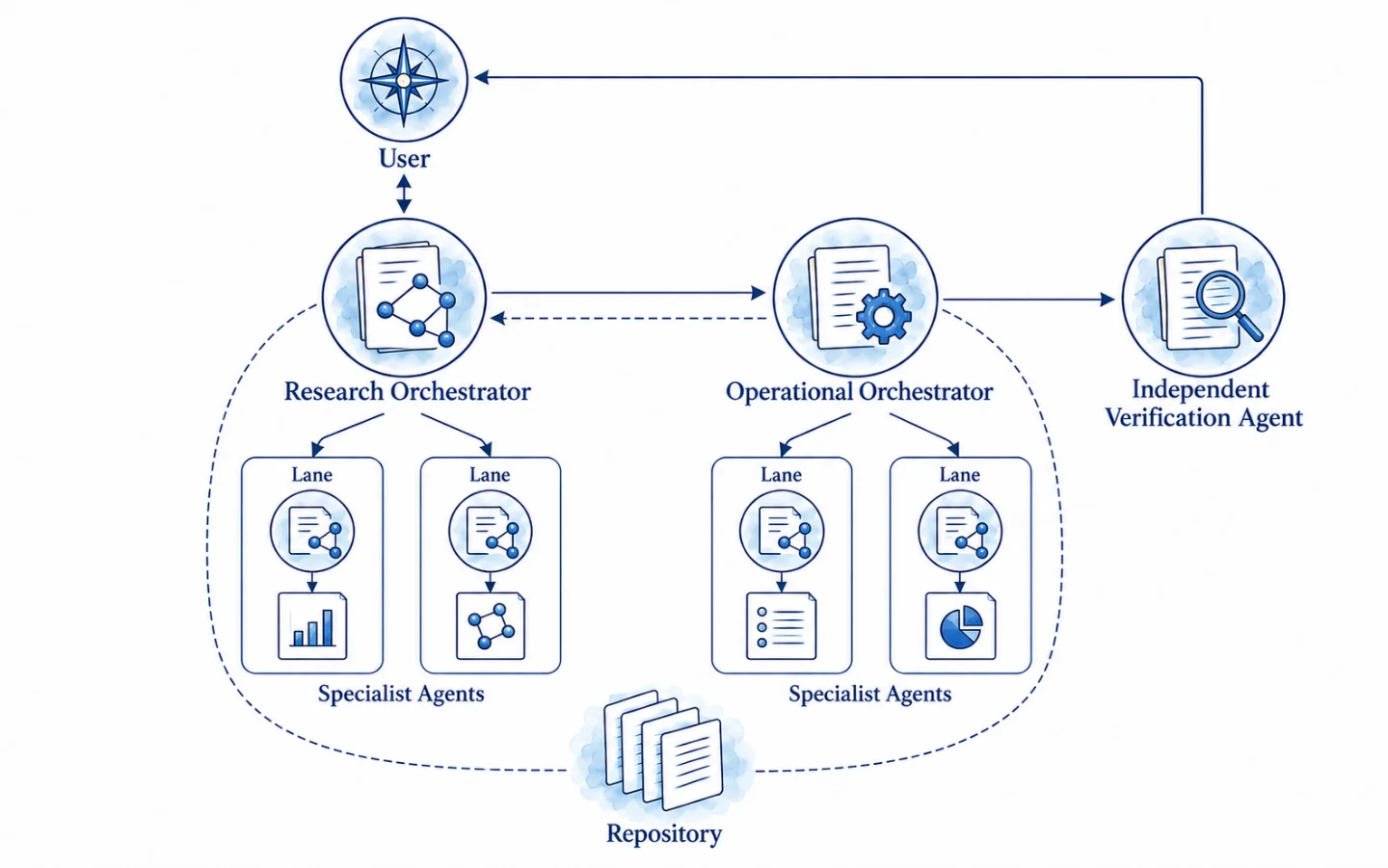
  • Research Mission Control with the User at the top, a Research Orchestrator, an Operational Orchestrator with Specialist Agents and an Independent Verification Agent that reports to the User, all arranged around a shared repository.
    Generated with gpt-image

    Research Mission Control

    Research Mission Control divides clarifying, implementing and checking among AI agents working on a shared repository.

    Release Candidate

Principles

  • Project knowledge and method

    Work begins with an understanding of the project, its research question, its data and its workflows. This knowledge is recorded in a project knowledge base and versioned with the code. The method of context engineering follows from it, for example Promptotyping, Grounded Vault, an agentic pipeline or a simple work cycle with one agent.

  • A framework for coding agents

    The quality of agent-generated code depends on the context in which the agents work. We design this framework from the knowledge base, precise requirements, sample data from your holdings and automated tests that the agents run themselves.

  • Declared maturity

    Results are prototypes and research tools whose maturity is openly declared. Productive operation, for example with sensitive data or many users, requires professional revision and an independent review of the code.

  • Open formats

    Results are held in open, documented formats, depending on the material TEI, PAGE XML, METS/MODS, JSON-LD or CSV. Image data can be integrated via IIIF. The data thus remain readable independently of the tool and can be transferred to other systems and repositories.

  • Expert control

    Where large language models are used, it remains discernible for every item whether it was generated by a model, checked by an agent or confirmed by your experts. Only content confirmed by your experts counts as established.

  • Handover

    You receive the complete source code and the project knowledge base, on the basis of which your team, external developers or AI assistants can continue the work. For research data we offer long-term archiving in the certified repository GAMS.

Who we are

Digital Humanities Craft is a company that grew out of research in the Digital Humanities, based near Graz. We develop research software and digital editions, teach at universities in Austria and Germany and work as a technical partner in funded projects. Team and projects

Process

  1. Initial conversation and assessment

    Using real files we discuss your workflow and clarify what is possible within the intended budget.

  2. Requirements and quotation

    Goal, data and acceptance criteria are recorded in writing.

  3. Prototype on your data

    A first working version is tried out in daily work.

  4. Testing and acceptance

    Your experts assess the result against the agreed criteria.

  5. Handover and support

    Tool, source code and knowledge base are handed over.

Good fit

  • Archives, museums, libraries and memorial sites
  • Universities, academies and research projects, also as a technical partner in funded projects
  • Companies and public administration with a workflow for which no suitable standard software exists
  • recurring work with files, lists or images that is currently done in Word, Excel or by hand
  • small projects, even a single work step
  • teams who want to learn to work with coding agents and knowledge bases themselves

Not a fit

  • Replacement for standard software with vendor support
  • general websites, online shops or public relations
  • projects without a subject contact for testing and acceptance
  • productive operation without an independent review of the code

Request a project

In conversation

Please describe your workflow briefly. The following details are helpful:

  1. Which workflow costs you time?
  2. Who does the work, and with what?
  3. Which files are involved, and in what volume?
  4. What should the outcome be?
  5. What budget is envisaged?

office@dhcraft.org

With documents

Send us what you already have. From it we build a first prototype on which the project can be discussed in concrete terms.

  • a one-page project description
  • sample data, for example a few typical files
  • your ideas of what the tool should do

office@dhcraft.org